TimberSteel
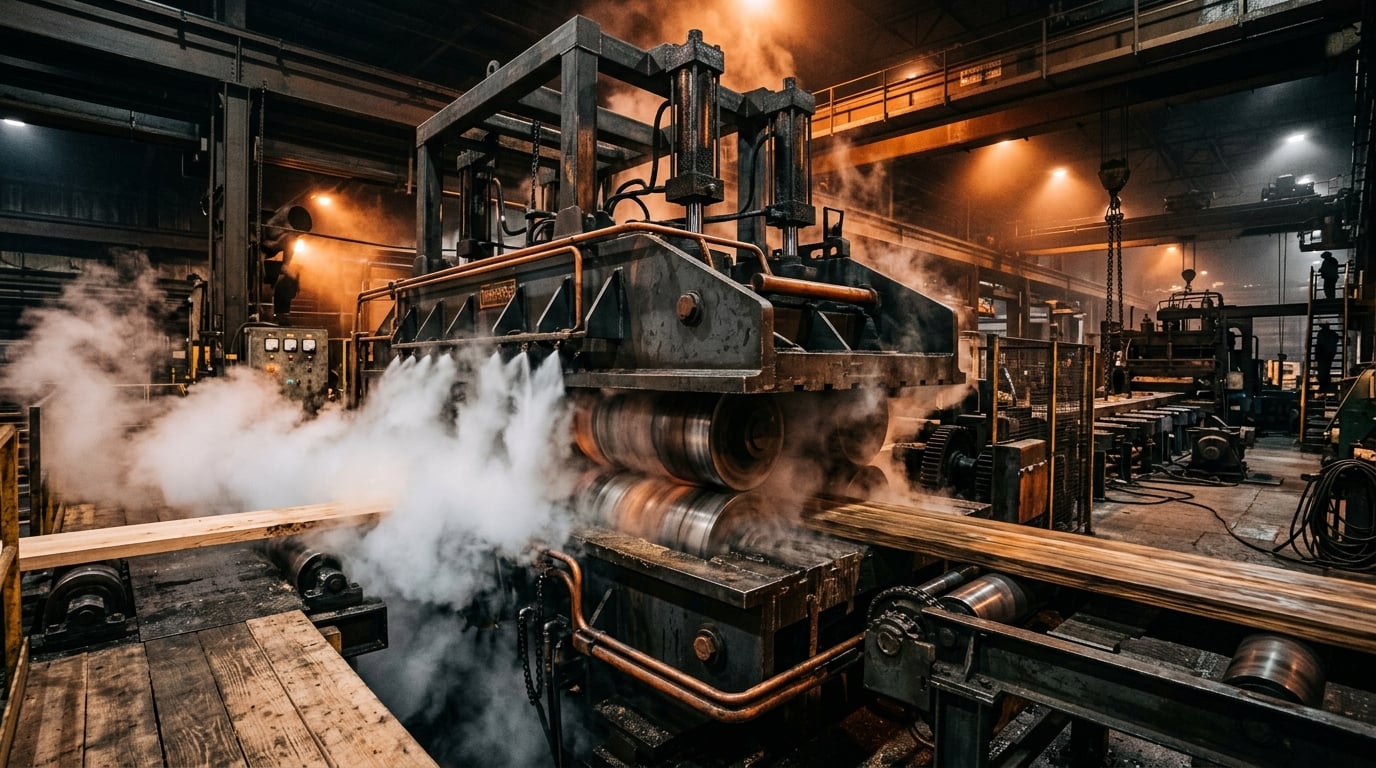
A plate-bracket roller mill that crushes and hardens every standard lumber size sold in commerce — from 1×2 boards to 8×8 timbers — into steel-strength structural material.
Two massive steel plates clamp shut under 800-tonne hydraulic force. Superheated steam blasts the incoming board to plasticize the lignin, then cool rollers slowly draw it through the nip — emerging at 8× the original strength.
How Steam + Rollers Turn Wood Into Steel
A three-stage process: chemical pretreatment, hot-steam plasticization just before the rolling nip, and slow mechanical compression between cool rollers. Standard lumber goes in — hardened structural material comes out.
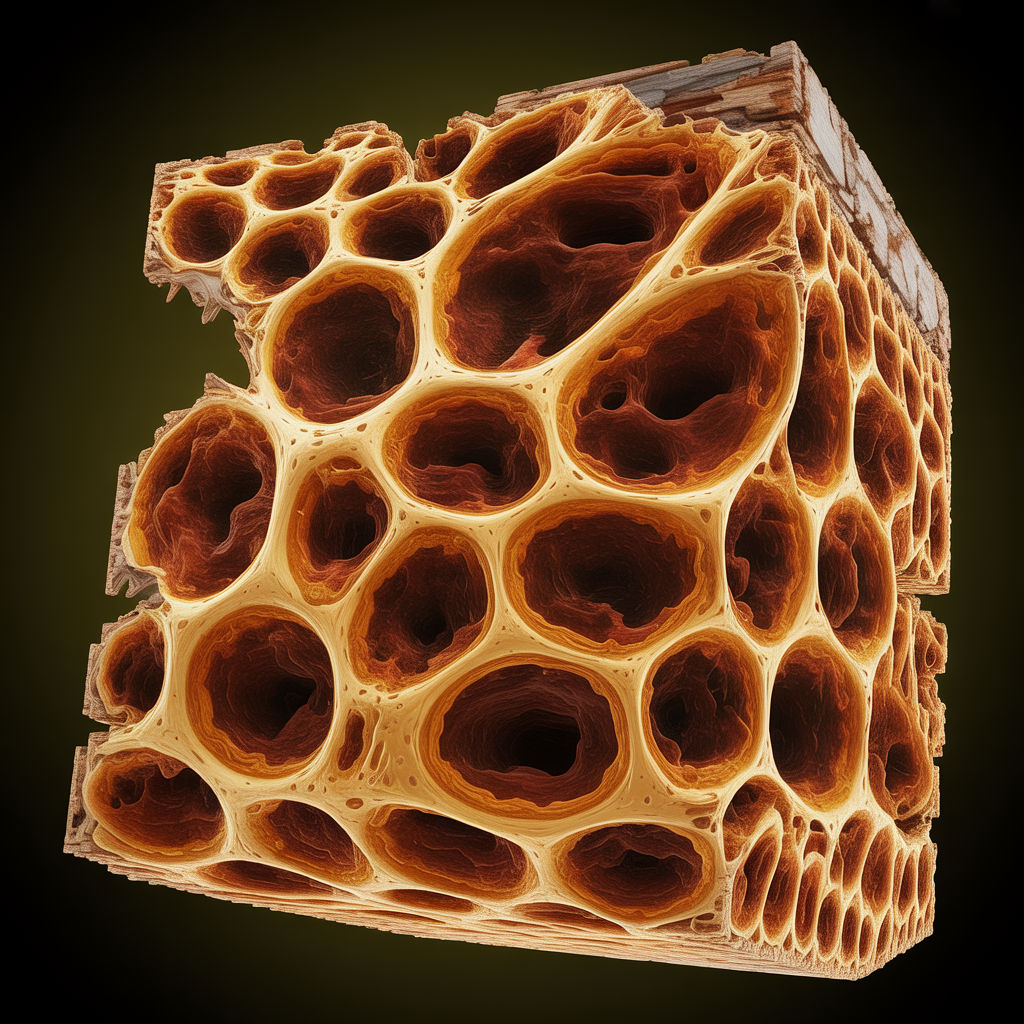
SEM cross-section showing compressed cell walls after steam + roller treatment — lumen volume reduced 70%
Partial Delignification
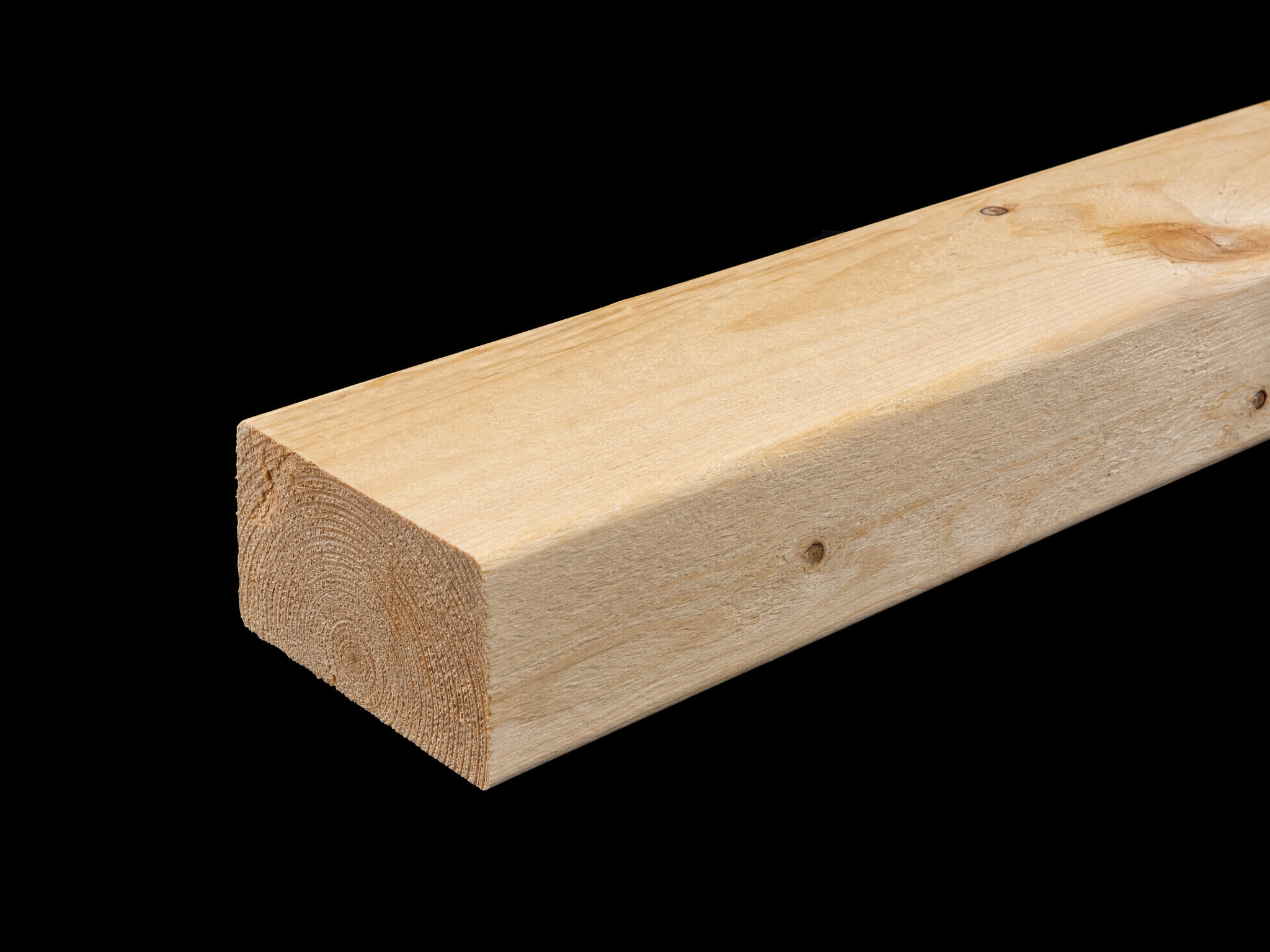
Standard SPF lumber is immersed in a NaOH/Na₂SO₃ solution that selectively removes lignin and hemicellulose. This softens the cell wall matrix, enabling deep densification when the board is later compressed in the roller mill.
Hot Steam Plasticization
Just before the rolling nip, a stainless-steel manifold blasts the pretreated board with 170 °C superheated steam at 0.4 MPa. The vapor simultaneously delivers heat (to plasticize residual lignin) AND moisture (to swell cell walls) directly at the wood surface — no need to heat the rollers themselves.
Slow-Feed Penetration
Cool steel rollers slowly draw the steaming board through the nip at 0.3–1.2 m/min. The deliberately slow dwell time — 8 to 20 seconds under the steam jet — lets vapor diffuse through the full board thickness so lignin softens uniformly before the plates clamp down with 800 tonnes of hydraulic force.
Cellular Densification & Bond Formation
The clamped rollers collapse the wood’s cell lumen by up to 70 % while the softened cellulose nanofibers stack and form dense hydrogen-bond networks. A standard 2×4 enters at 0.45 g/cm³ and exits at 1.10–1.20 g/cm³ — approaching the theoretical cell-wall density of 1.5 g/cm³.
Standard Lumber vs. TimberSteel
Side-by-side comparison of roller-pressed TimberSteel lumber against standard SPF, Douglas Fir, aluminum, and structural steel.
Every Commerce Size Supported
From 1×2 boards to 8×8 timbers — the mechanical mill swallows every standard dimensional lumber size produced in North American commerce. Feed any board, get back a hardened one.
Boards
1× nominal — sheathing, trim, furniture stock
Dimensional Lumber
2× nominal — studs, plates, joists, rafters
Posts & Heavy Timber
4× and larger — columns, beams, post-and-beam
| Property | Unit | SPF | Doug Fir | TimberSteel | Al 6061 | Steel A36 |
|---|---|---|---|---|---|---|
| Density | g/cm³ | 0.45 | 0.53 | 1.15 | 2.70 | 7.85 |
| Tensile Strength | MPa | 40 | 65 | 340 | 310 | 400 |
| Specific Strength | kN·m/kg | 89 | 123 | 296 | 115 | 51 |
| Janka Hardness | lbf | 690 | 660 | 5,800 | — | — |
| Modulus of Elasticity | GPa | 8.9 | 13.4 | 38 | 69 | 200 |
| Compression Ratio | × | — | — | 2.5× | — | — |
| Moisture Absorption | %/24h | 85 | 72 | 12 | 0 | 0 |
| Dimensional Recovery | % | — | — | <3 | — | — |
| Thermal Conductivity | W/m·K | 0.12 | 0.14 | 0.30 | 167 | 50 |
| Carbon Footprint | kg CO₂/kg | -1.8 | -1.7 | -1.4 | 8.1 | 1.9 |
Plate-Bracket Roller Mill
Two massive steel plates form a clamping bracket around the rolling zone. Hydraulic cylinders push the plates together; superheated steam pre-conditions the board just before it enters the cool rollers. The wood is fed slowly so the steam fully penetrates before the nip closes.
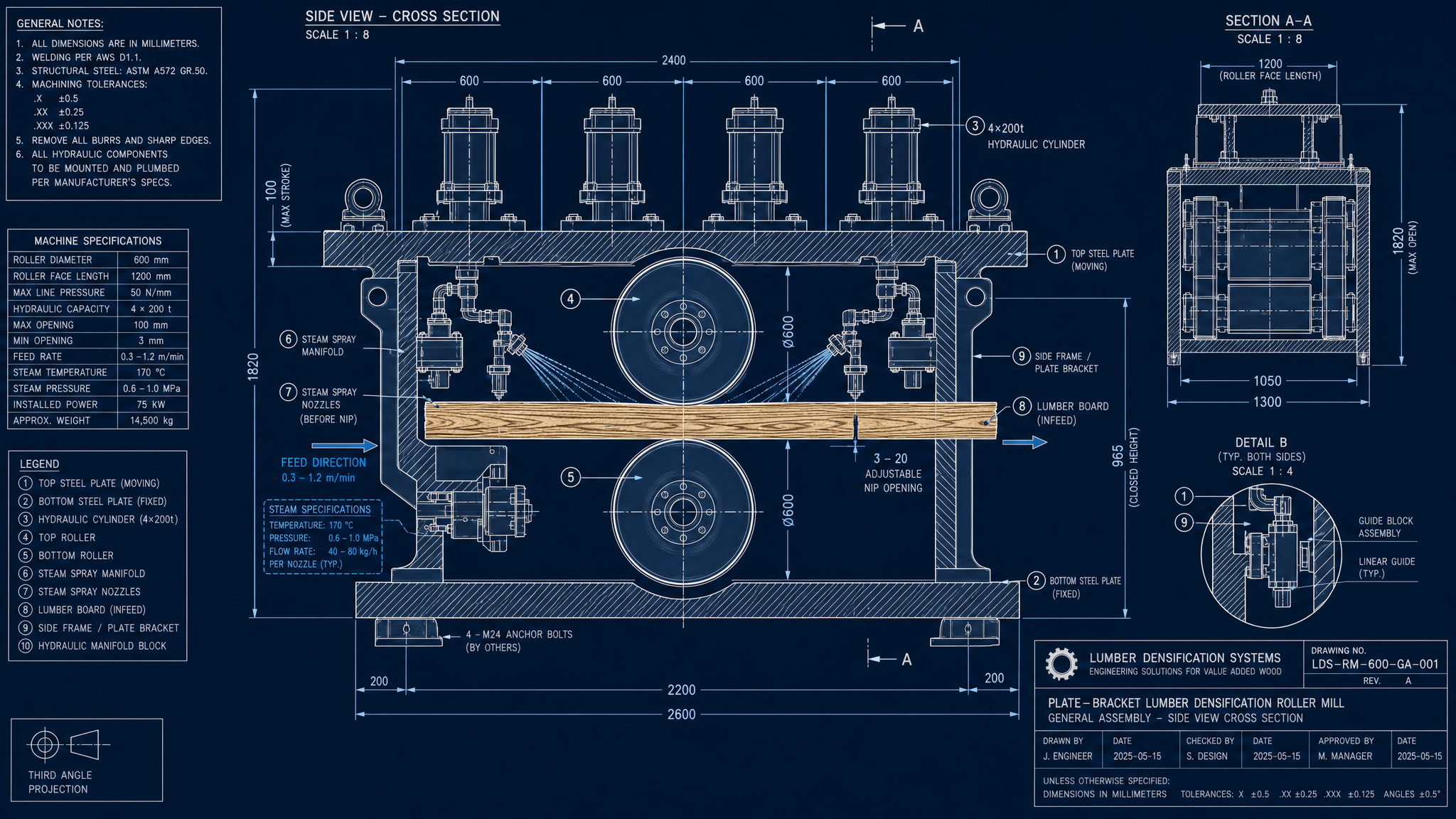
System Overview
Click any marker on the blueprint to explore subsystems. Two steel plates form the bracket; hydraulic cylinders clamp them shut; superheated steam pre-conditions the board before it reaches the cool rollers; the rollers slowly draw the lumber through.
3.2 × 1.8 m
Footprint
600 mm
Roller Ø
8,500 kg
Weight
800 t
Press Force
170 °C
Steam Temp
0.3–1.2 m/min
Feed Rate
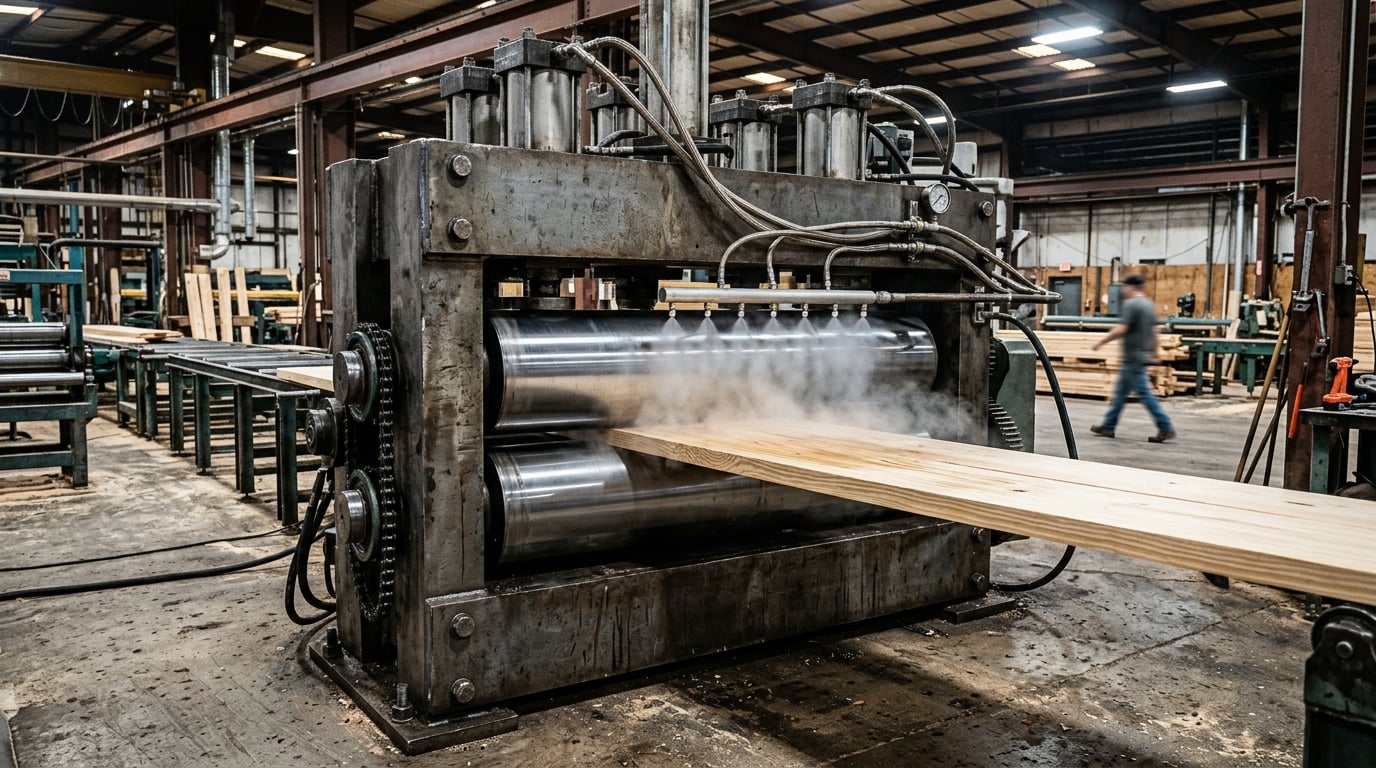
Production Unit
Compact plate-bracket mill — 3.2 m footprint, 8,500 kg, 800 t hydraulic clamp force
Operational Flow
Standard Lumber In
1×2 → 8×8 · every commerce size
Density: 0.45 g/cm³
Pretreated SPF
Steam + Compression
170 °C vapor · 800 t clamp
Feed: 0.3–1.2 m/min
Cool rollers, hot steam
Hardened Lumber Out
8× strength · same size
Density: 1.15 g/cm³
Strength: 340 MPa
From Lumber Yard to Steel-Grade
A five-stage industrial pipeline: chemical pretreatment, hot-steam plasticization, hydraulic plate-clamped roller densification, consolidation, and finishing. Standard lumber goes in one end — hardened structural material exits the other.
Lumber Intake & Sizing
Standard commerce lumber — every nominal size from 1×2 boards to 8×8 timbers — is selected and sorted. Boards are verified for dimensional accuracy and moisture-equilibrated to 12 % MC before processing.
Chemical Delignification
Lumber boards are immersed in boiling NaOH/Na₂SO₃ solution (7 % w/w) for 5–7 hours depending on cross-section thickness. This removes ~40 % of lignin, softening the cell wall matrix so the wood can be deeply compressed by the rollers without fracturing.

Steam-Plasticized Roller Compression
The pretreated board enters the mill. A multi-nozzle manifold blasts 170 °C superheated steam onto the wood at 0.4 MPa just before the rolling nip — plasticizing lignin and saturating the cell walls. Two cool steel rollers, clamped between massive top and bottom plates by 800 t of hydraulic force, then slowly draw the wood through. The plates apply the load; the rollers stay cool; the steam carries all the heat.
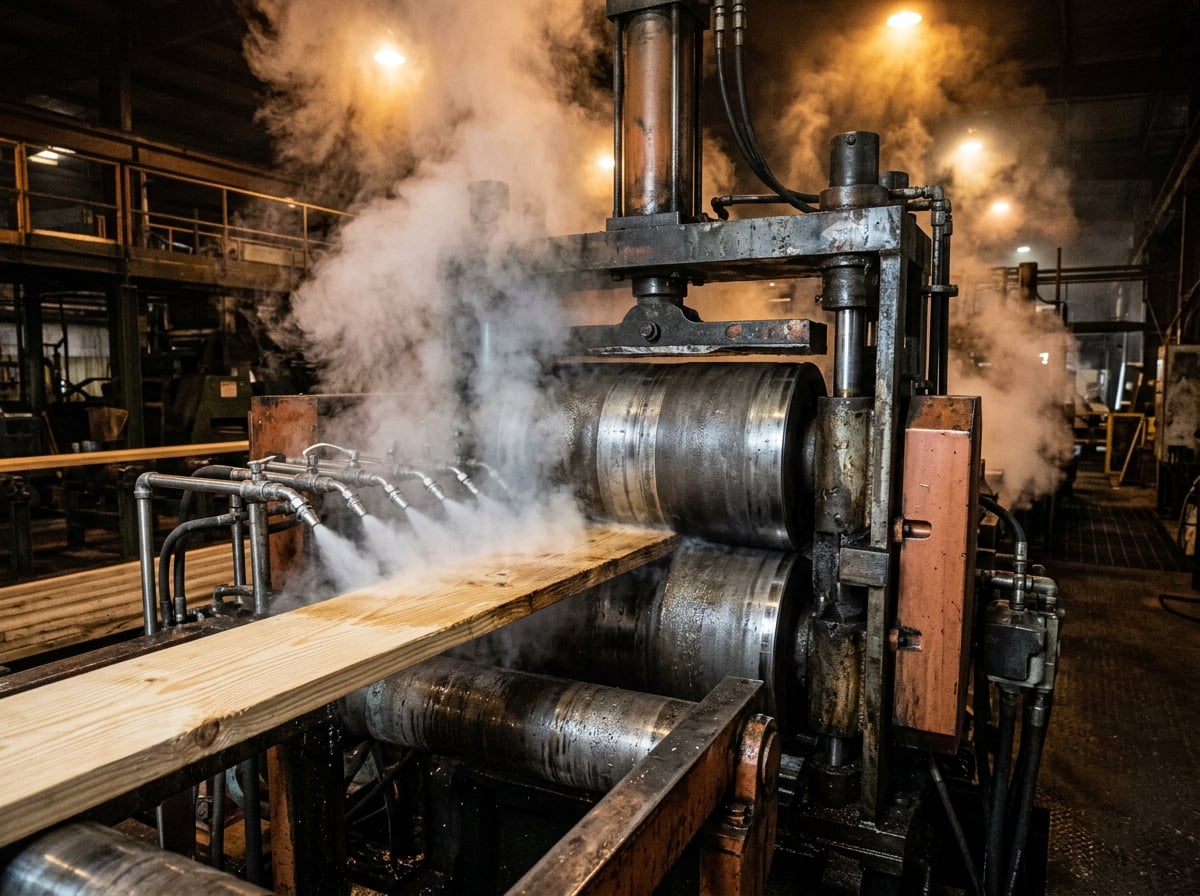
Consolidation & Cooling
Hydrogen bonds form between exposed cellulose nanofibers at cell wall interfaces during and after roller compression. The board passes through a cooling zone where residual steam vents and the densified state locks in — preventing springback and ensuring dimensional stability for service.
Hardened Lumber Output
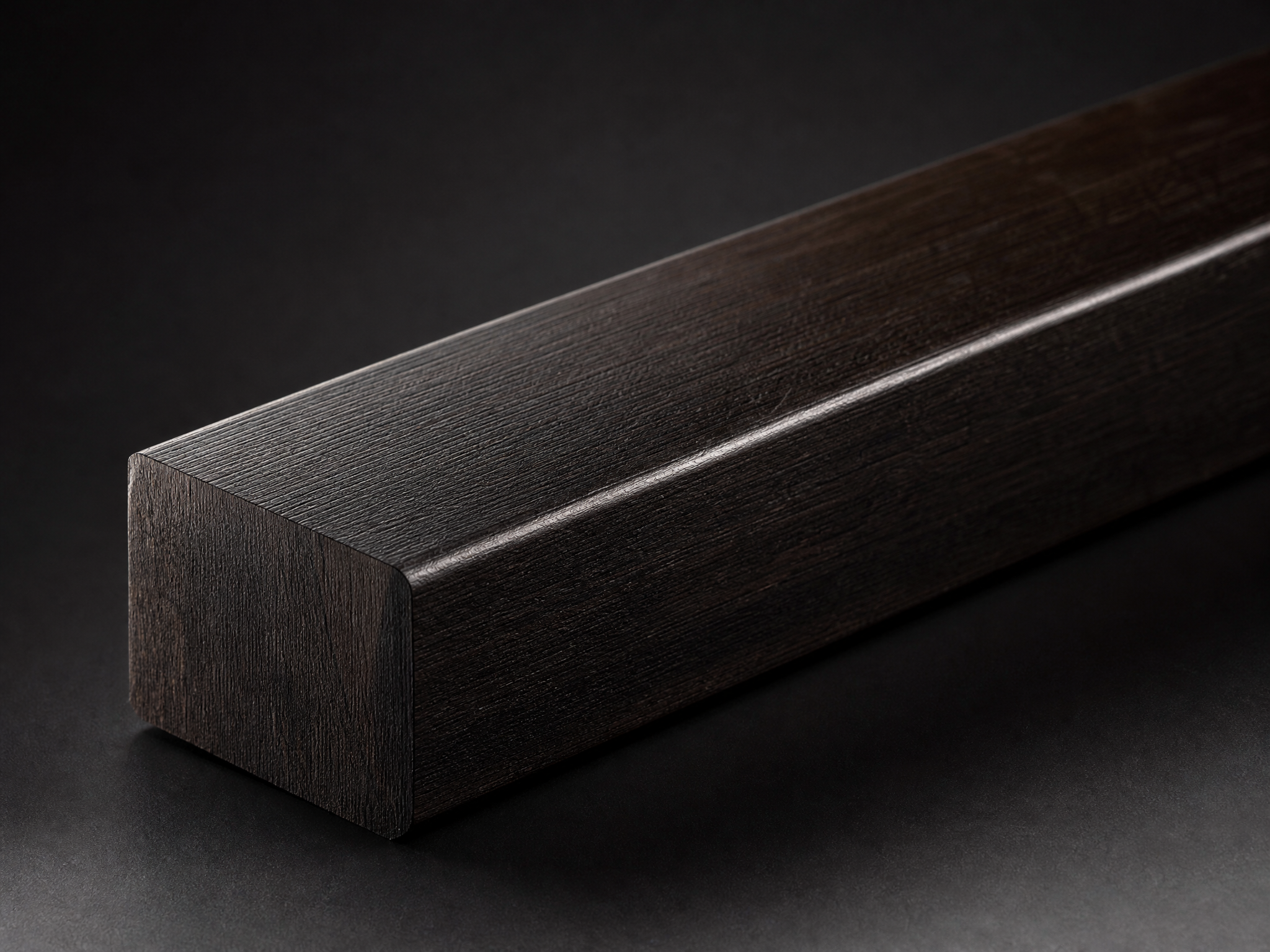
The resulting board achieves 1.10–1.20 g/cm³ density with tensile strength of ~340 MPa (approaching aluminum). Each board retains its nominal size profile and is graded, stamped, and ready for construction with standard nails, screws, drills, and saws.
Built for Real Construction
From 1×2 trim boards to 8×8 timbers — every standard commerce lumber size drops into existing construction workflows with dramatically improved performance.
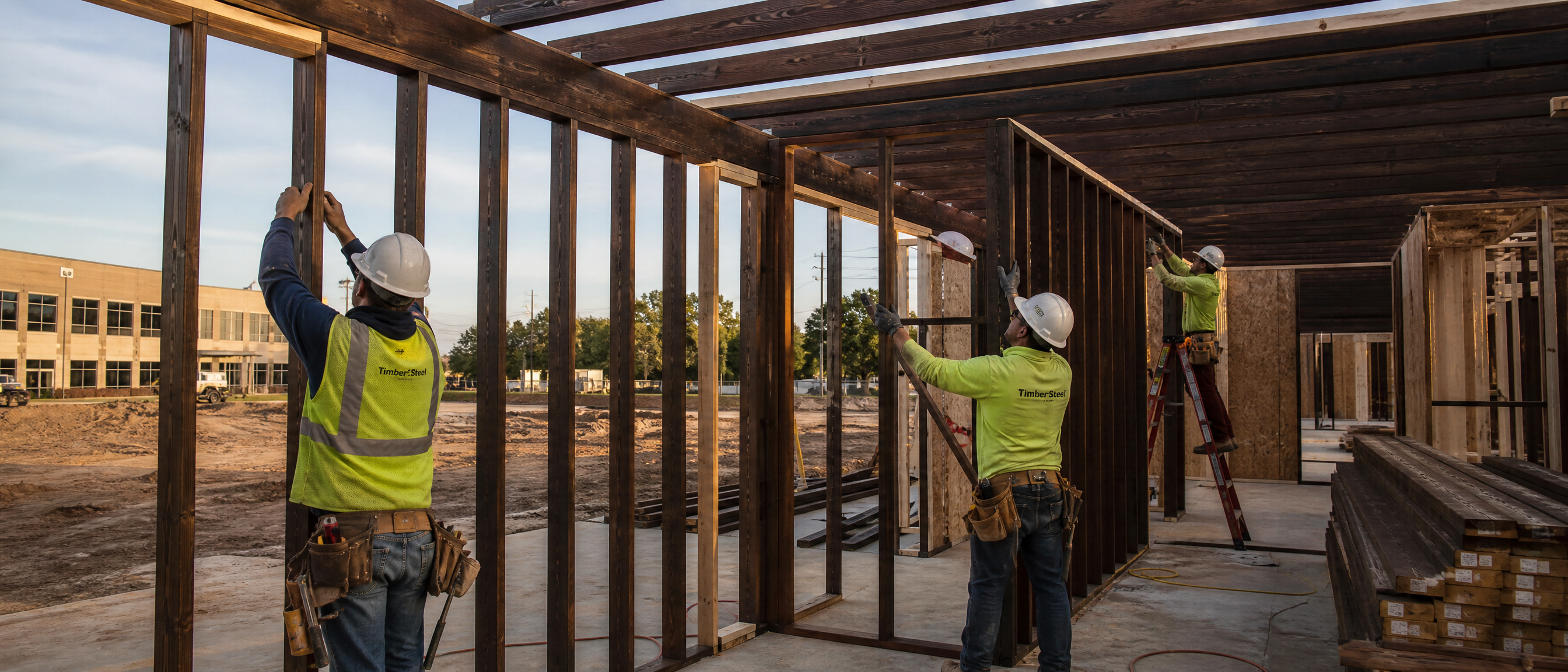
Hardened lumber installed in standard framing — same tools, same fasteners, 8× the strength.
Structural Framing
Load-bearing wall studs, headers, and plates in any standard size — from 2×3 partition framing to 2×6 exterior walls. A TimberSteel 2×4 carries the same load as a steel stud — use standard nail-gun fastening, no special tools needed.
Floor & Roof Joists
Hardened 2×8, 2×10, and 2×12 joists span greater distances with less deflection. Reduce joist count or increase spacing while maintaining code-compliant load ratings.
Exterior & Siding
Extreme moisture resistance (12% vs 85% absorption) makes hardened lumber ideal for exterior cladding. 1×4 through 1×12 boards, and 1×3 trim, with no pressure treatment chemicals needed — naturally rot and insect resistant after densification.
Decking & Fencing
1×4 to 2×6 decking and fencing lumber outlasts pressure-treated wood by 3× in outdoor applications. Janka hardness of 5,800 lbf means zero denting from furniture, foot traffic, or weather impacts.
Posts & Heavy Timber
Hardened 4×4, 4×6, 6×6, 6×8 and 8×8 posts and beams for structural columns, pergolas, and post-and-beam construction. The mechanical mill handles thick cross-sections with full-depth densification — up to 8×8 in a single pass.
Sustainable Construction
Every TimberSteel board retains a negative carbon footprint (-1.4 kg CO₂/kg). Replace steel studs, aluminum framing, or concrete components with renewable, carbon-sequestering hardened lumber.